Into the Glacier: Guide to Langjökull's Man-Made Ice Tunnel
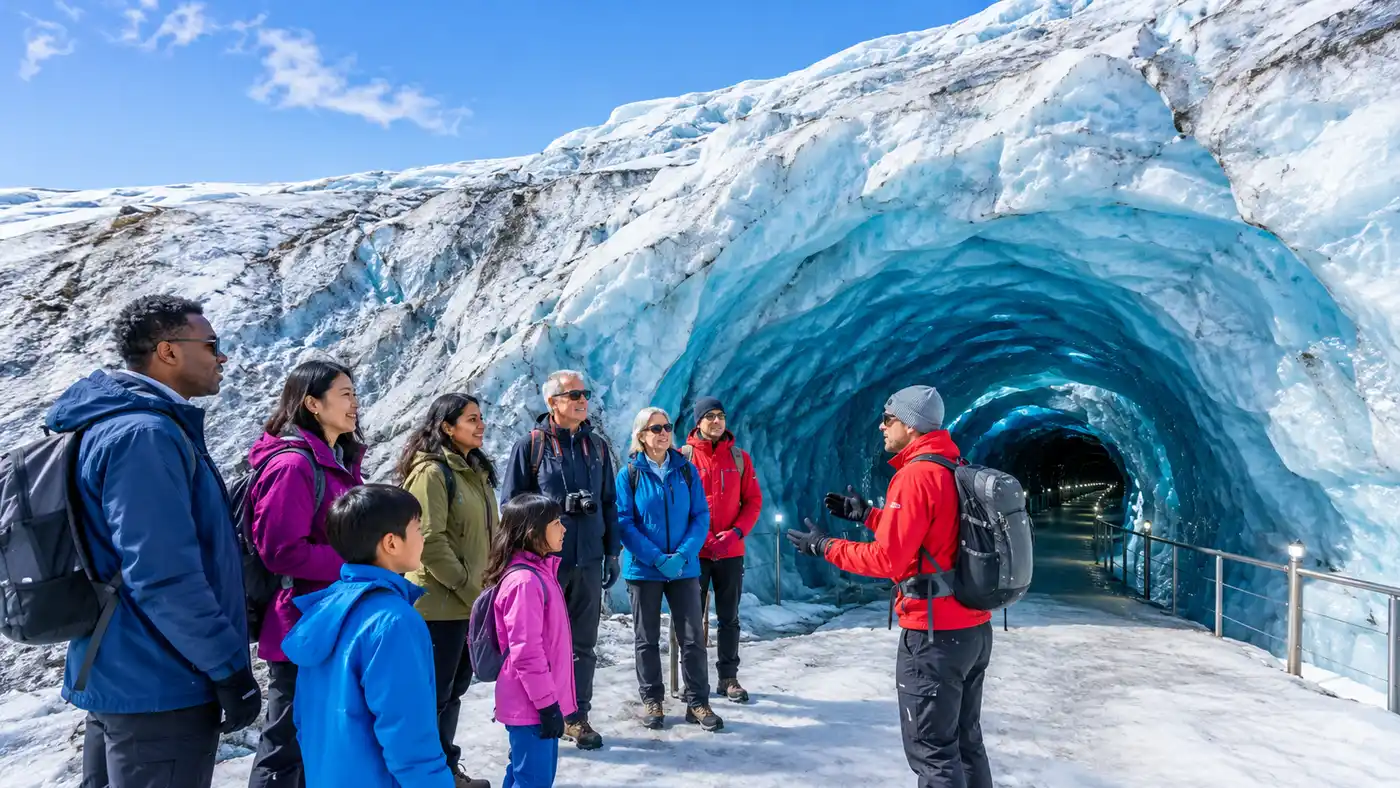
You hear the ice before you see it. Beneath your boots, there is a dull, hollow crunch, followed by a faint rumble as thousands of tons of ancient compressed snow settle around you. Stepping into the belly of Langjökull on an into the glacier tour iceland changes how you think about ice caps. You are not standing on a glacier looking at a vast white desert under the sky. You are walking thirty meters underneath it, enclosed by glowing blue corridors that were dug directly into the frozen heart of Iceland's second-largest glacier.
Most travelers visit Iceland hoping to catch a glimpse of the icy wilderness. Few realize you can actually step directly into an enormous ice tunnel system carved through solid ice. This guide walks you through what to expect on this underground adventure, how to get there, what to wear, and how this human-made marvel compares to the wild, ephemeral winter caves found elsewhere on the island.
Book your langjokull glacier iceland experience:
What Exactly Is the Langjökull Ice Tunnel?
The project began as an ambitious, somewhat crazy dream shared by two local tour operators, Baldvin Einarsson and Hallgrímur Örn Arngrímsson. They wanted to show everyday travelers what geophysicists had been studying for decades: the internal anatomy of an active ice cap. After four years of engineering studies, excavation started in 2014. By mid-2015, the ice tunnel opened to the public, stretching roughly 500 meters into the solid ice sheet at an altitude of about 1,260 meters above sea level.
It is currently the largest man-made ice tunnel on earth. Heavy mining machinery carved out vaulted chambers and gentle walking corridors, removing thousands of cubic meters of hard ice. Because glaciers move constantly under their own weight, the entire tunnel is a living structure. Langjökull creeps downhill by a few centimeters each year, meaning the ceiling slowly compresses and shifts. The guides inspect and trim the walls regularly, keeping the pathways clear and safe for visitors.
Walking through the Langjökull ice tunnel feels a bit like boarding an alien subterranean base. Recessed LED fixtures line the floors, casting a soft white and deep sapphire glow against the carved walls. Look closely at the walls and you will see distinct horizontal stripes running across the ice like tree rings. These dark bands are volcanic ash layers from eruptions that took place decades or even centuries ago, preserved perfectly in the deep freeze. There is ash from the 2010 Eyjafjallajökull eruption, and darker bands from violent Katla eruptions centuries back. It is a vertical timeline of Iceland's geological violence, trapped behind glass-clear ice.
Note: The tunnel stays at a constant temperature of roughly 0 degrees Celsius (32 degrees Fahrenheit) all year round, regardless of whether it is an August afternoon or a blustery January morning outside.
Getting There and Booking Your Into the Glacier Tour Iceland
Reaching the entrance is half the adventure. You cannot simply pull up in a compact rental car and walk in. The tunnel entrance sits high on the desolate ice cap of Langjökull, accessible only by custom-built 8-wheel drive monster trucks originally designed as NATO missile carriers. These beasts have massive low-pressure tires that deflate automatically to crawl over slush, crevasses, and deep drifts without sinking.
Most travelers either book a full-day package starting in Reykjavik or drive themselves to the staging points in West Iceland. If you drive yourself, your journey will lead through the scenic Borgarfjörður region. You can meet the transfer vehicles at Húsafell, a lovely woodland oasis offering cabins, a bistro, and geothermal pools. In the summer months, adventurous drivers with sturdy four-wheel-drive vehicles can push further along the gravel tracks to Klaki basecamp, situated right at the edge of the glacier moraine. If you are debating routes, read our breakdown on driving up to Langjökull before setting out on the rough gravel roads.
Here is how the common tour setups compare so you can plan your logistics and budget realistically:
| Tour Option | Starting Point | Total Duration | Approx. Cost (ISK / USD) | Key Highlight |
|---|---|---|---|---|
| Classic Ice Tunnel | Klaki Basecamp (Summer only) | 2.5 hours | 22,000 ISK (~$160) | Shortest ride; direct glacier access |
| Standard Day Tour | Húsafell Center | 3.5 to 4 hours | 26,500 ISK (~$195) | Includes mountain truck transfer |
| Reykjavik Day Trip | Reykjavik Terminal / Hotel | 9 to 10 hours | 38,000 ISK (~$280) | Includes Hraunfossar waterfalls stop |
| Tunnel & Snowmobiling | Gullfoss or Húsafell | 5 to 6 hours | 44,000 ISK (~$325) | Glacier snowmobiling plus tunnel walk |
Tour slots sell out weeks ahead during peak summer and the December holiday season. Booking ahead online is basically mandatory if you have a tight itinerary.
The Journey Inside: What to Expect Inside of Glacier Tunnels
The tour begins at Klaki basecamp or Húsafell, where you board the giant monster truck. The ride up the mountain slope takes about 35 to 45 minutes. It is bumpy, noisy, and exhilarating. On a clear day, the views stretch out over hundreds of kilometers of barren volcanic highlands. On stormy days, you experience an authentic Icelandic whiteout, where sky and ground blend into a seamless wall of swirling fog and wind. Inside the heated cabin of the truck, you barely care.
Upon reaching the tunnel portal, the vehicle pulls up next to a low wooden structure half-buried in drift snow. You step out into the freezing wind, and a guide ushers you quickly through heavy double doors into the hillside. Instantly, the wind dies away. Silence takes over. The air turns still, crisp, and smells extraordinarily clean, like the interior of an old, spotless commercial freezer.
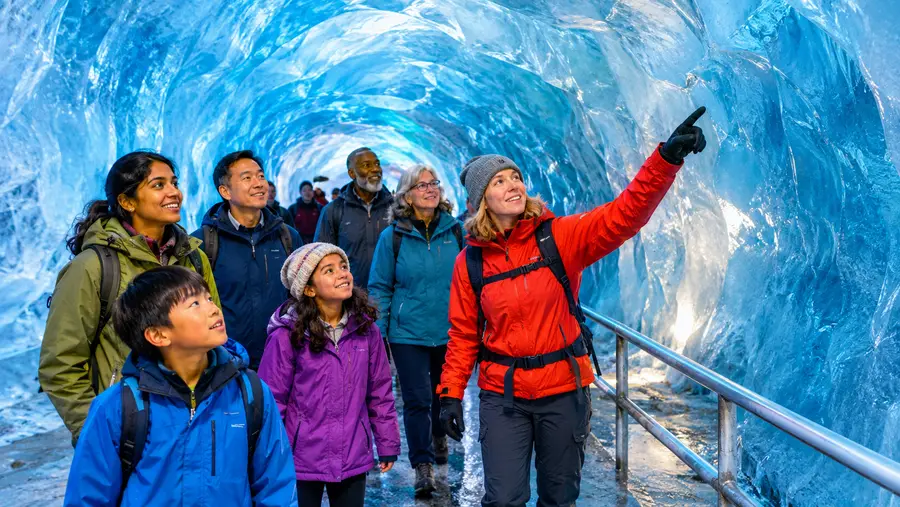
Before heading down the incline, everyone slips simple traction cleats or crampons over their hiking boots. The walking surface is relatively flat, but it is made of hard-packed frozen ice, sometimes slicked with meltwater near the entrance. The guide leads you down long gently sloping corridors illuminated by warm light strips carved into the floor.
Pro tip: Keep your phone or camera tucked inside your coat against your body until you want to take a picture, because cold tunnel air drains lithium-ion batteries in roughly fifteen minutes.
As you walk deeper, you will discover several carved side chambers:
- The Subterranean Chapel: A large, vaulted room complete with wooden benches and an ice altar. It possesses incredible acoustics, and people genuinely travel here to hold intimate wedding ceremonies and vocal performances.
- The Deep Crevasse: A narrow footbridge takes you across a yawning natural crevasse that cuts right through the man made ice cave iceland engineers excavated. Looking down into the dark abyss reveals how fragile glaciers actually are.
- The Science Niche: An educational chamber where guides explain the glaciology of Langjökull, showing how snow transforms under crushing pressure from fluffy firn into dense, crystalline blue ice over decades.
- The Reflection Chamber: A quiet alcove where the lighting is dialed down, letting you witness the pure, unadulterated blue hue that only dense, bubble-free glacier ice can produce.
You spend roughly an hour inside the tunnel network. It sounds like a short time, but because the temperature is chilly and the walking is slow, it feels unhurried. The guides keep groups spaced apart, so you rarely feel crowded while snapping photos of the arched passages.
Book your langjokull glacier iceland experience:
What to Wear and Pack for a Glacier Tunnel Visit
Do not underestimate the cold. Even if it is a pleasant 15 degrees Celsius down by the coast in Reykjavik, high on Langjökull you are exposed to alpine weather. Once you step inside the glacier tunnel, you are essentially standing inside a massive ice chest. You are not running around generating heat; you are strolling slowly and stopping constantly to listen to your guide.
Dressing properly makes the difference between marveling at thousand-year-old ice and shivering uncontrollably while staring at your watch. Use a dependable three-layer system:
- Thermal base layers: Synthetic or merino wool leggings and a long-sleeve top. Avoid cotton at all costs because it holds moisture and leaves you clammy.
- Insulating mid-layer: A heavy fleece sweater or a lightweight packable down jacket that traps warm air against your torso.
- Waterproof outer shell: Windproof and waterproof pants and jacket. The tunnel ceiling occasionally drips cold meltwater, particularly near the entrance during summer.
- Sturdy ankle-high hiking boots: Flexible running shoes or soft winter fashion boots do not work well with the crampons provided at the entrance. You need firm soles.
- Warm accessories: A snug beanie that covers your ears, a neck gaiter, and water-resistant gloves. Bulky ski gloves can make operating your camera tricky, so consider touch-screen liner gloves under a warm shell.
A small backpack is handy for holding a water bottle and stashing spare clothing layers. Large backpacks will just get in the way when passing other travelers in the narrower passages.
Comparing the Experience: Man-Made Ice Cave vs Natural Ice Caves
Travelers often ask whether they should visit the Langjökull ice tunnel or search for a natural ice cave in the south of Iceland near Vatnajökull. Honestly, they are completely different experiences, and both have distinct advantages.
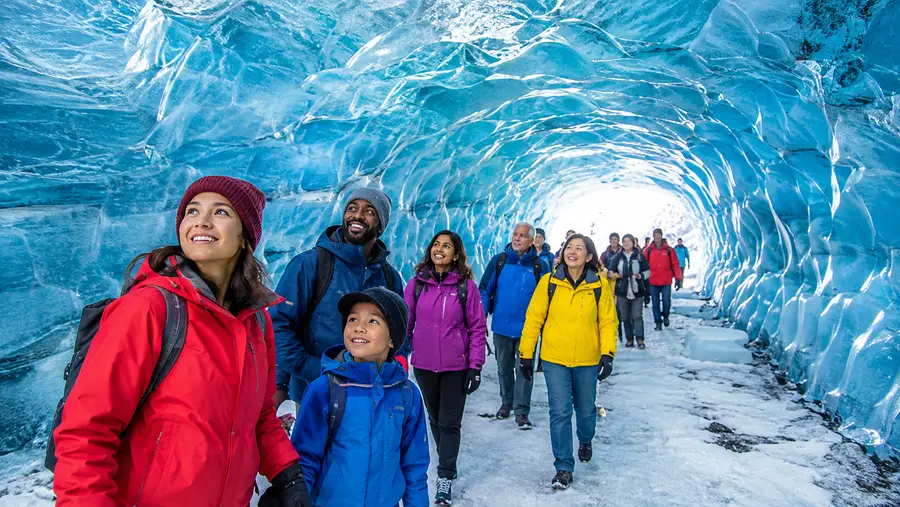
Natural ice caves form strictly during the winter months when summer meltwater torrents carve drainage pipes through the glacier and then drain away in the autumn freeze. Because these caves are wild natural formations, they are unstable. They flood during rainstorms, collapse when temperatures rise in spring, and vary wildly in size from year to year. You can only visit them safely between November and March. When conditions are right, their wavy, glass-smooth sapphire ceilings look like frozen ocean waves, which is undeniably breathtaking.
The man made ice cave iceland excavated into Langjökull offers something entirely different: reliability, stability, and scale. Because it was engineered with structural safety in mind, it is open 365 days a year. If you visit Iceland in June, July, or September, this is effectively your only opportunity to walk deep inside a glacier. Natural caves simply do not exist safely in summer.
The tunnel also lets you go much deeper into the ice cap than almost any natural cave permits. You travel hundreds of meters away from daylight, observing how ancient snow is compressed into solid crystal. It feels educational, mysterious, and monumental. Natural caves, by contrast, feel wild, brief, and fragile. If you come in mid-winter, you might choose to do both. If you are traveling between April and October, the Langjökull tunnel is the uncontested champion.
Frequently Asked Questions about into the glacier tour iceland
Is the into the glacier tour iceland suitable for young children or older travelers?
Yes, absolutely. The walking paths inside the tunnel are smooth, flat, and gently graded without steep ladders or difficult scrambles. As long as participants can walk comfortably for about an hour and handle cold temperatures, children aged five and up as well as active seniors do very well on this excursion.
Can I visit the ice tunnel on my own without a tour?
No, you cannot. The tunnel is located deep within an active, crevasse-riddled ice cap and is kept securely locked for safety reasons. You must join an authorized guided excursion that provides the necessary heavy transport, safety equipment, and certified glacier guides.
Is it claustrophobic inside the ice tunnel?
Most people find it surprisingly spacious. The main corridors are roughly three meters wide and nearly three meters tall, so you rarely need to duck or squeeze through tight gaps. The soft interior lighting and steady airflow keep the space feeling open rather than suffocating.
Will my tour be canceled if the weather is bad?
The tunnel itself is completely immune to surface weather, but extreme blizzards or high winds on Langjökull can occasionally make the mountain truck transfer too dangerous. If road conditions prevent the trucks from reaching the glacier, operators will reschedule your trip or issue a full refund.
Quick Reference
- Location: West Langjökull Ice Cap, Iceland
- Operating season: Open year-round, daily
- Internal temperature: Constant 0°C (32°F)
- Time inside tunnel: Approximately 50 to 60 minutes
- Vehicle used: 8x8 modified ex-military super truck
Book your langjokull glacier iceland experience:
Is It Worth It?
Iceland has no shortage of jaw-dropping landscapes, but standing underneath dozens of meters of ancient blue ice is something that stays with you long after the mud on your hiking boots has dried. It is an engineering feat that bridges the gap between raw natural glaciology and accessible human curiosity. Whether you combine it with a snowmobile ride across the surface or take your time exploring the quiet corridors on a self-drive journey from Reykjavik, stepping inside Langjökull offers an intimate look at our changing planet that few places on earth can replicate.
Read more about langjokull glacier iceland.